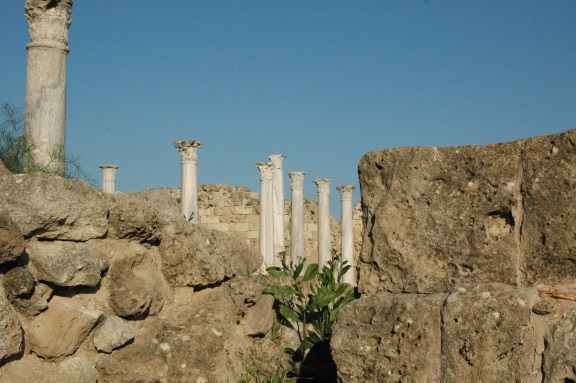
Cyprus is an island that has been inhabited for over 9,000 years, from the Neolithic Stone Age to the civilised 21st century, mankind has walked this fertile land.
Early settlers most probably came from nearby countries, with Turkey only 40 miles away the journey would not have been difficult. Artefacts found in Neolithic settlements have clear links with similar finds on the mainland and there are many villages of the period dotted across the island.
During the Chalceolithic period (3900-2600BC) copper was discovered and found to be a durable and exportable commodity. It was during this time that the trade routes, which were to be so important in future centuries, were established.
With the Early and Middle Bronze Ages came the development of the first real towns and commercial centres, and due to trade, cultural relations with neighbouring countries improved. There was a steady influx of immigrants from nearby lands among them the Myceneans who developed trading cities around the island, such as Enkomi in the north and Paphos in the south. They brought with them Greek cultural methods and started producing decorative pottery not just for the home market but also for export.
The Iron Age coincided with a slowing down in commercial growth and a dispersal of the peoples. Those that continued to live on Cyprus carried on their traditions until they were given a boost by the arrival of the Phoenicians. Links with the Orient were made, the economy grew and religion started to change. Worship of the Mycenean Horned God, was replaced by the cult of Astarte, Goddess of Fertility. She in time was replaced by Aphrodite, always considered to be a native of Cyprus.
In the following centuries, the island came under the domination of many foreign powers mostly from the Near East. Dues were paid to Assyria, Egypt and Persia. It was during the control by the Persian Empire that many of the city kingdoms were permitted to mint their own coinage.
During the Classical Period (475-325BC) the Cypriot people attempted to rebel against Persian rule but were for the most part defeated. It was not until the arrival of Evagoras who claimed the Kingdom of Salamis that the yoke of Persia was thrown off. However, Evagoras successfully developed good trading relations with Persia and Salamis became a powerful commercial city.
Prosperity through trade continued to grow throughout the Hellenistic and Roman periods until the decline in fortunes of the Roman Empire. It was not to recover until Constantine the Great pulled the Western Empire together under Christian rule and thus Cyprus became part of Byzantium. As a commercial centre Cyprus was important enough for the Emperor Justinian to have it classified as a province of the Empire and it continued to grow wealthy.
In the 7th C AD marauding Islamic hordes plundered many of the cities, sacking, looting and burning as they went. Many beautiful Christian buildings were destroyed and whole townships abandoned. The raids lasted for over two hundred years and the Cypriot people were obliged to pay taxes to whichever Caliph was in power, and to Constantinople. This injustice continued until the Byzantine Emperor defeated the Arabs and made the island secure once again.
The last Byzantine ruler of the island was the self-styled Emperor of Cyprus Isaac Comnenus who had usurped power from Constantinople during the chaos that followed the fall of Jerusalem to Saladin in 1187. After eight years of despotic rule, he made a grave political error by attempting to capture Berengaria of Navarre when her ship was driven onto the shores near Limassol during a storm. As a foreign princess she should have been offered courtesy, instead of which she received only insults. Her future husband Richard I king of England came to her rescue, snatched the island from the usurper, sent Isaac into exile and married his bride in Limassol castle in May 1191.
Delighted as he was to find a treasury full of gold, Richard had no use for the island and sold it to the Knights Templar. Then with his new found and much needed wealth he continued on his third crusade to retake Jerusalem.
It was not long before the Templars discovered that the Cypriot people were not prepared to put up with another regime of harsh rule and went into hostile rebellion. With their resources already stretched by the crusade, the Templars requested that king Richard relieve them of the island. As some small recompense for the loss of Jerusalem, Richard handed the island over to Guy of Lusignan and thus began 300 years of French rule.
Initially being ruled by a dynasty from France was no more beneficial to the Cypriot people than the previous rule. It introduced a feudal system that gave power to the barons who had supported Guy during his battles in the Holy Land. However some local laws and customs were retained and gradually peace among the people was restored.
Guy was never crowned as king of Cyprus, it was his brother Amalric who succeeded him in 1194 who was granted the Crown of Cyprus by the Holy Roman Emperor Henry IV in 1197.
Tenaciously, the Kings of Cyprus continued to hold on to the title of King of Jerusalem long after all hope of regaining that Kingdom was lost, and they were crowned (in absentia) in the great Cathedral of St. Nicholas in Famagusta.
The Orthodox religion was oppressed and the number of Orthodox Bishops was reduced. Though not totally forbidden the faith was pushed out into the less wealthy areas and the revenues amassed by the Orthodox Church were re-allocated to the Church of Rome.
Religious suppression angered the endemic Cypriots who mistrusted their new overlords, and the continuing contrast in lifestyles with the building of flamboyant abbeys and churches demonstrated the increasing divide between the two distinctly differing peoples. However over the next three centuries this was to change and ultimately Cyprus and her people derived great benefit from the period of French rule.
Although there were times when foreign powers cast envious eyes on the realm of Cyprus resulting in attempts to take the island, there were also periods of great peace. There were enlightened rulers such as Hugh III, who encouraged the widespread interest in cultural reform and promotion of the arts. His court was known throughout Europe for its brilliance and his reign was spent mostly in the country not journeying about other countries of the Mediterranean, a fact that endeared him to the Cypriots.
However the next monarchs were not so lucky and their reigns were marred by interfamily feuds. Relative calm was restored by Hugh IV, who though somewhat an intolerant monarch, was a man who loved beautiful things and it was during his rule that the final additions to Bellapais Abbey were made.
In 1359 Peter I came to the throne and started his rule well. However after only seven years his reign started to decline; his trusted advisers died and he was at the mercy of the barons who undermined him and his evil Queen, Eleanor. She eventually succeeded in having him assassinated and became co-regent with her brothers in law until her infant king Peter II attained his majority.
During the coronation of Peter II a long brewing feud between Venetian and Genoese nobles erupted and developed into full scale war. The Genoese landed in force in 1373 and plundered many of the cities, churches and abbeys. They took and held Famagusta and captured James the Constable, who had been one of the co-regents, and held him prisoner.
The hapless young king was completely controlled by his mother who succeeded in having her other co-regent Prince John, murdered.
Peter II died without issue, James still imprisoned by the Genoese became heir and managed to raise the ransom for his release. He reorganised the kingdom and was succeed by his son Janus. The country was once more prospering when in 1426 Egypt invaded and the island was controlled by a foreign power.
The next sixty years saw a sad decline in the monarchy as French rule came to an end. The last Lusignan monarch was James II who succeeded in driving the Genoese out of Famagusta with financial help from Venice. He married a Venetian, Catherine Cornaro and died in somewhat suspicious circumstances leaving his widow to rule. His posthumous son died at a year old and Catherine ruled for thirteen years until the persuasive powers of her native Venice became too much for her and she abdicated the throne in 1489.
For the next eighty years Cyprus became a Venetian stronghold. The towns, cities and coastal fortifications were strengthened against the growing might of the Ottoman Empire. All their efforts to make the island safe against further invasions were in vain when the Ottoman forces landed at Larnaca in 1570 and rapidly took Nicosia in a swiftly savage siege. Kyrenia gave in without a shot being fired, leaving the last major city Famagusta to be conquered. The taking of Famagusta took ten long months, during which the Ottoman forces suffered tremendous losses at the hands of the small but brave force within the city walls led by Marc Antonio Bragadino. Courage and bravery were insufficient when the city ran out of supplies and Bragadino was forced to surrender.
With the total island now conquered, the new Ottoman rulers made changes that the Orthodox Cypriots welcomed. The churches were handed back to their former owners, Catholics, long hated by the Orthodox faith were expelled and many of the Catholic churches became mosques.
The population of the island was increased by settlement from the mainland of Turks who were promised gifts of land by the Sultan. However there were still taxes to be paid and financially the people did not find themselves much better off. Corruption in Government was rife, poverty and famine wreaked havoc, and a great plague in the mid 17th C decimated the population.
Taxes were reduced and the Ottoman authority appointed the Orthodox Archbishop as the representative of the people. Thus tax collecting was put into the hands of the church, a system that worked for a short while until greed got the upper hand, once again reducing the peasants to penury.
The Russian Empire was slowly chipping away at its common borders with Ottoman possessions and the British Government was asked for help in stopping further incursions. A deal was brokered between the Sultan and Benjamin Disraeli which permitted control of Cyprus by the British Government which in turn would continue to pay taxes to the Sultan. It was expedient for Britain to control the island because the Suez canal had opened in 1869 and it was feared Russia would try to take it and command the newly opened trade route.
The British undertook many reforms that benefited the island, new roads and bridges were built, water pipelines for the villages, and crop irrigation were installed, a railway was constructed to link Famagusta, Nicosia and Guzelyurt.
With the outbreak of the first world war, Turkey joined forces with Germany and Cyprus was annexed to the British Crown. In 1915 Britain offered the island to Greece if they would agree to fight with the allies. Greece declined the offer. In 1925 the island became a crown colony under the control of a governor.
Enosis, (union with Greece) which would have been automatic if Greece had accepted the offer of the island in 1915 became of great importance. There were riots in 1931 and Government house was burnt to the ground. With the onset of the second world war, Cypriots both Turkish and Greek fought in the British armed forces. At the end of the war the call for Enosis was renewed. In 1950 Archbishop Makarios called for a vote of the people on the subject of enosis and over 95 percent voted in favour. The British were not prepared to relinquish the island at the time and the battle for self rule was led by the EOKA rebel leader George Grivas with the blessing of Makarios.
Despite the request for Enosis being outlawed and Makarios being sent into exile, Greece applied to the United Nations for the right to self-government, the Turkish Cypriot minority were not taken into account as they were not considered of any importance. An eventual solution was reached and the London Accord that granted the island its independence was signed in 1959, with the Republic of Cyprus becoming an actuality in 1960.