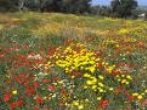
flora north cyprus

Cyprus is an island which overall has an abundant variety of flora. Concentrating on the North, in excess of a thousand kinds were collected by Dr. Deryck Viney between 1988 and 1993. In 1994 an illustrated publication of his findings was produced under the title, “An Illustrated Flora of North Cyprus” and it is an invaluable guide to the amateur or professional botanist. There are over a hundred Cyprus endemic species and nineteen North Cyprus endemics to be searched for, with Spring being the best time to do it. Late February to the end of April are the optimum months for seeing Cyprus in bloom. Though there are many woodland species that will emerge during the winter months, such as cyclamen, narcissi, crocus and muscari. Flower availability will depend tremendously on the previous winter rainfall, and excessive heat in April may bring a premature end to the flowering season. However there are hardy wildflowers that continue to bloom well into May and June.

The first colour of Spring is the bright yellow of the Oxalis pes-caprae. An agricultural nuisance but a welcome splash of colour in the drab landscape, this is soon followed by the anemones in white, pale mauve, blue and red, and after them come some of the Ophrys and Orchis species, for example Ophrys fusca (the Brown Bee Orchid) and Orchis morio (Green-winged Orchis) are widespread and can be found in the pine forests and on rocky hillsides.   The  Mandrake (Mandragora officinarum) has flowers in the white to dark blue spectrum and grows as a flat cluster of broad green leaves with the flowers nestling in the middle. It can easily be seen along the road-sides and on many of the ancient sites. The Crown Daisy, (Chrysanthemum coronarium) covers the fields and verges with pale orange, bathing the countryside in sunshine.

As the weather starts to get warmer, the most colourful of the Spring flowers clothe the scene. Asphodels, Calendula and three varieties of Cistus (Cistus creticus, Cistus parviflorus and Cistus salviifolius) produce a palette of varying shades in every direction. The giant fennel (Ferrula communis) is an inedible plant and grows unchecked in fields and mountains. It grows to a height in excess of 2m with a feathery leaf, used by the local florists in flower arrangements. With many heads of bright yellow flowers, towering over all other species it is unmissable.

The vibrant blues of the anchusas (Anchusa azurea, tall, bright and hairy, and Anchusa undulata, low growing, dark blue almost purple), mix with the paler blue of the Dyer’s alkanet (Alkanna Lehmanii), and the equally colourful echiums, (Echium angustifolium, narrow-leaved Bugloss, and Echium plantagineum, viper’s Bugloss).

Flowering from February to May are the ranunculus that grow in the foothills of the mountains. The turban buttercup or Persian crowfoot (Ranunculus Asiaticus), grow in a variety of colours from cream to yellow, deep scarlet, and white flashed with red. Though similar, they are not to be confused with the anemones that share the same habitat.

The common pink corn flag (Gladiolus italicus) can be found in the corn fields as can the Cyprus black tulip (Tulipa cypria), not truly black but very dark red, it is a Cyprus endemic that is becoming rare due to the destruction of its habitat.

The Arabian sun rose (Fumana Arabica)and the endemic Cyprus sun rose (Helianthemum obtusifolium) favour the same habitat and are very similar, with papery thin yellow petals, growing in rocky terrain they flower from February to May.

Key TakeAways

There are various tourist information offices in North Cyprus:

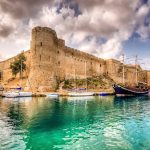
Kyrenia – in the Old Harbour
Lefkosa – by Kyrenia Gate
Famagusta – the Land Gate (the main entrance to Famagusta old town)
Ercan Airport – located inside the airport

Most electrical plugs in North Cyprus are the 3 pin type, the same as in the UK.

Occasionally, three to two pin adaptors are necessary, however this is quite rare nowadays.

North Cyprus observes the religious holidays of Islam and like the religious holidays in the Christian Church they are moveable feasts.

Ramadan is a period of fasting followed by three days of feasting called Kurban Bayram (feast of the Sacrifice). The date of Ramadan changes each year.

Other major holidays are:

New Years Day, January 1st.

Children’s Day, April 23rd.

Labour Day, May 1st.

Youth and Sports Day, May 19th. Peace and Freedom Day, July 20th.

Communal Resistance Day, 1st August.

Victory Day 30th August.

Turkish National Day, 29th October.

Independence Day 15th November, (proclamation of TRNC in 1983).

The currency in North Cyprus is the Turkish Lira, which has a constantly fluctuating exchange rate. For this reason, shopkeepers and restaurant owners are fully conversant with all major currencies and bills can be paid in UK Sterling, Euros and US Dollars as well as local currency.

If you change your money into Turkish Lira in North Cyprus, you will generally get a much better exchange rate than you would otherwise get in the UK.

There are many money exchange bureaux in all of the major towns. Major UK Credit and Debit cards are widely accepted, and can be used in cash machines, however you should ensure that you inform your bank before you travel so that they do not block your card. You should also enquire about charges to use your card abroad.

Travellers Cheques as well as Scottish banknotes are not widely accepted in North Cyprus and changing them can be very difficult.

If you have an accident, or have a medical emergency, you can visit one of the state hospitals in Kyrenia, Famagusta or Lefkosa. Private hospitals are also found in most towns.

Minor cuts and bruises will be treated usually free of charge in the state hospitals. However, major medical treatment can incur a hefty bill and it is essential that you take out comprehensive insurance cover for your holiday, and that your insurance covers you for Turkey as well as Europe. Please ensure that any pre-existing medical conditions that you may have are notified to the insurance company prior to travel. Failure to notify them may well render the insurance cover null and void.

Please note that the European Health Insurance Card (EHIC) is NOT accepted in North Cyprus.

Police: 155
Fire: 199
Forest Fires: 177
Ambulance Emergencies: 112

General Hospitals

Nicosia/Lefkosa 0392 2285441
Kyrenia/Girne 0392 815 2226/8152254
Famagusta/Magusa 0392 3662876/3665328
Guzelyurt 0392 7142125

Dialling Codes

To call a phone in North Cyprus from elsewhere you need to dial 0090 followed by either the code for landline numbers: 392 or for mobiles 542 or 533.
There are two mobile service providers in North Cyprus; KKTC Telsim which uses the 542 prefix and Turkcell which uses 533.
Mobile numbers are usually supplied with the necessary code to facilitate access.

When dialling from North Cyprus to the UK enter 0044 followed by the number required with the deletion of the initial zero.

On This Page

Explore More
Kyrenia
Famagusta
north-cyprus-karpaz-tour-3
Karpaz
Nicosia

News & Inshigts of Kyrenia

Best Travel Theme

Elementor Demos

With Love Travel WordPress Theme you will have everything you need to create a memorable online presence. Start create your dream travel site today.

Discover the World, one Full Adventure at a Time!

Our Contacts

Address

1080 Brickell Ave - Miami

United States of America

Email

info@travel.com

Phone

Travel Agency +1 473 483 384

Info Insurance +1 395 393 595

Follow us